The question that gets skipped
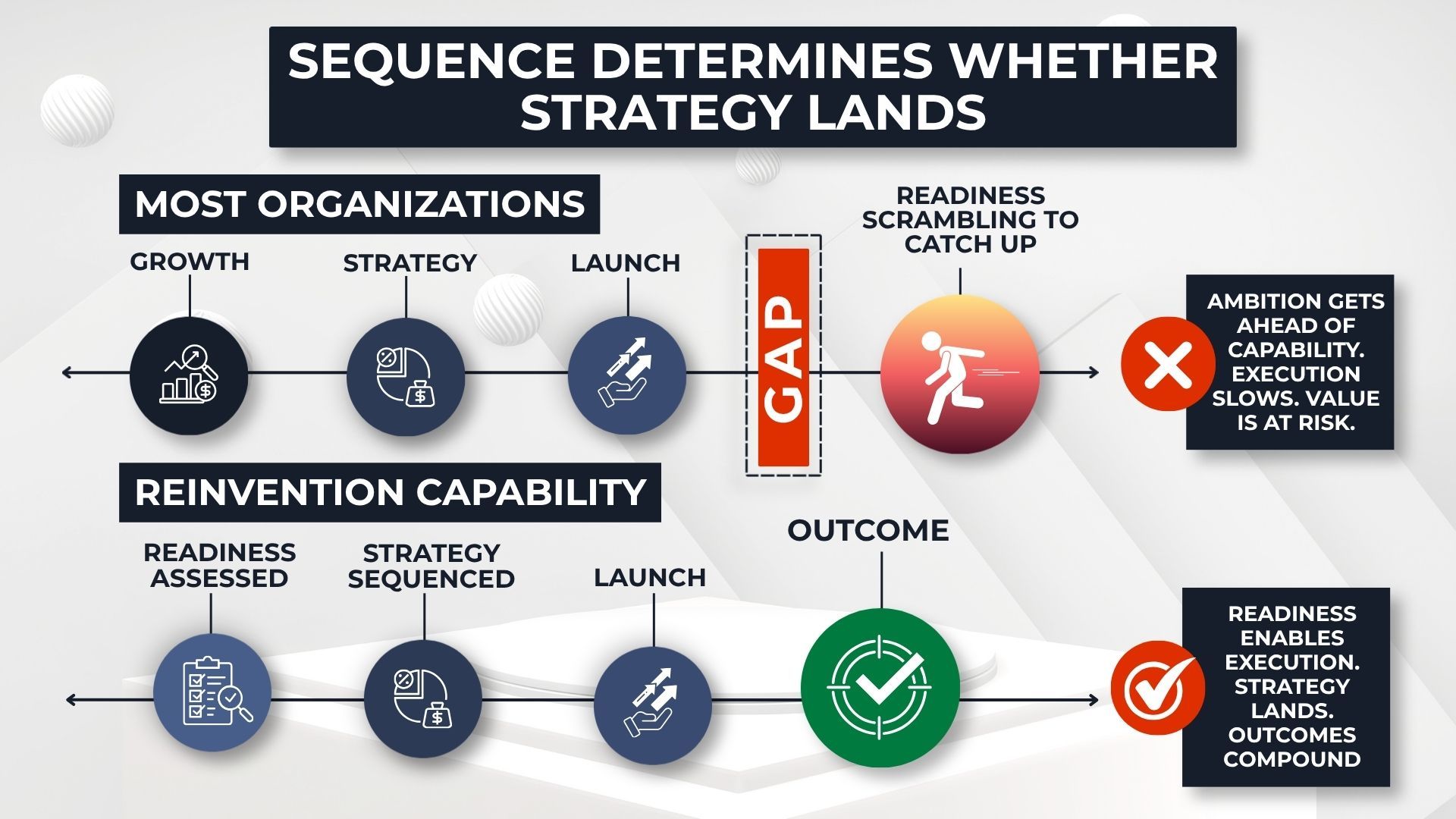
When executives evaluate a strategy, the questions that get asked are usually about ambition, market, and timing. The questions that don't get asked, or get asked too late, are about whether the organization, as it is right now, is designed to deliver what's being committed to.
Not whether the people are talented. Not whether the leaders are committed. Not whether the budget is approved.
Whether the organization has the capacity, capability, and alignment to absorb the move without fracturing.
That sounds tactical. In practice, it's one of the most strategic questions an executive team can ask. Skipping it is what turns sound strategies into stalled implementations and disappointing returns.
What readiness actually means
Readiness is a layered diagnostic, not a single check. There are several conditions an organization has to meet before it can absorb a structural move, and the gap between them is usually where transformations stall.
I'll preview the full diagnostic framework at the ALP National Conference in July. For now, three signals worth watching:
The structure assumes capability the organization hasn't built. The new design is correct on paper. The people inside it haven't yet been developed to operate at the level the design requires.
The leaders championing the change are not yet operating in the mindset the change requires. The executives sponsoring the move haven't internalized the shift themselves, and it shows up in their language, their meetings, and what they choose to escalate.
Known capacity gaps are treated as a downstream problem. Everyone in the room knows the bandwidth isn't there. The plan moves forward anyway, with an unspoken assumption that capacity will appear once the redesign is announced. It doesn't.
When all three are present, growth before readiness has stopped being a risk and become a reality already in motion.
The cost is invisible until it isn't
Growth-before-readiness gets expensive in the months after launch, when the leadership team is asking why the new structure isn't producing the expected outcomes, why the change isn't landing at the team level, why the strategy looks correct on paper and isn't translating in practice.
By then, the organization is committed. The investment is sunk. The diagnostic that would have surfaced the gap before the move has to be run in the middle of execution instead, which is harder, slower, and more expensive than running it before the strategy was finalized.
This is where Reinvention Capability™ — the organization's capacity to absorb continuous change without fracturing — becomes the deciding variable. The discipline is to assess it before launch, not after the transformation stalls.
The strategy question worth asking
Before the next major move, ask one question honestly:
Is the organization, as it stands today, designed to absorb what we're about to commit to or are we assuming readiness we haven't yet built?
If the answer is unclear, that's the signal. The work is upstream - surface the gap, decide what to do about it, sequence the move accordingly.
That's where the most expensive failures get prevented.
If this pattern is showing up in your strategy work, I'd welcome the conversation.
— Leslie Ellis, Founder & CEO, Meaningful Change Consulting